

5th MicroFrancophonie Summit: in Saint-Étienne, the OMF finds renewed momentum

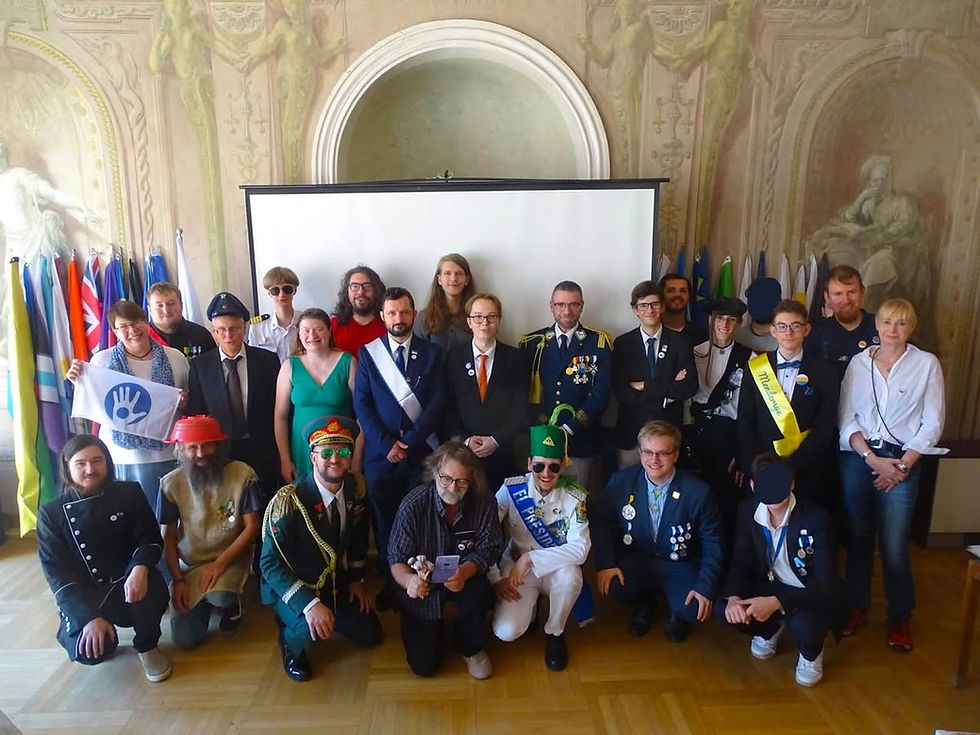
After the turbulence of 2025, the Organization of Micro-Francophonie (OMF) seems to have found its way back to dialogue and cooperation. Meeting in Saint-Étienne on October 24 and 25, the micronational delegations participated in a fifth summit focused on water and ecology. While concrete commitments are still to be defined, this edition has above all revealed the emergence of a new generation of micronationalists, determined to write the next chapter in the organization's history.

A summit organized in record time
The undertaking was audacious. Announced on August 29th by the new Secretary General of the OMF, His Serene Highness Prince Rémi de Ferthroy, the holding of the fifth MicroFrancophonie Summit left only two short months to prepare for an international gathering.
The Participatory Republic of Dibistan was entrusted with the responsibility of hosting the delegations in Saint-Étienne. This was a first experience of this scale for its two main organizers, Émilien Gallet and Uwe-Ute Krzyjanski, Ambassador to Unknown Territory.
Despite this particularly tight schedule, the event did indeed take place, demonstrating the mobilization capacity of an organization that some might have thought definitively weakened after the upheavals of the previous year.
In a statement released after the summit, Ambassador Uwe-Ute Krzyjanski made no secret of her satisfaction, summarizing this fifth edition in two words: "A success!"

Dialogue as the primary ambition
Prince Rémi de Ferthroy had the honor of officially opening the proceedings of this fifth edition.
In his opening address, the Secretary General emphasized the importance of dialogue in building peace, stressing the need for representatives of micronations to meet in person, moving beyond the virtual exchanges that often characterize their relations.
He invited the delegations to get to know each other, share their experiences, and discover the diversity of a rapidly evolving Francophone micronational scene. This desire for closer ties was already, in itself, a significant objective for an organization that had undergone a profound institutional crisis in 2025.

Conferences combining heritage, sport and the environment
The conference program explored several facets of contemporary micronationalism.
Prince Vincent I of the Principality of Hélianthis presented the role that micronations can play in promoting local territories and heritage. Through various examples, his presentation demonstrated how these entities can contribute to a region's attractiveness and enhance its international profile, in collaboration with local stakeholders.
Martin Condor, President of Cliponie, focused on the place of sports and esports within the micronational landscape. His presentation explored the history of sporting competitions between micronations and their geopolitical dimension, reflecting the challenges facing sports on an international scale.
These insightful presentations highlighted the diversity of micronational initiatives, even if they strayed somewhat from the central theme of this year's event.
Water, a unifying theme… but still few commitments
Because this fifth edition aimed above all to place water and its preservation at the heart of the discussions. A particularly relevant choice at a time when the challenges related to access to drinking water, resource scarcity, and climate change affect all territories, regardless of their size or international recognition.
However, it must be noted that relatively few presentations directly addressed this theme.
The Principality of Gehenzed, participating remotely via videoconference, nevertheless shared how water-related issues manifest themselves within its own territory. But it was undoubtedly the presentation by Aboubacar Touré, representing the Republic of Toubak, that gave this discussion its most concrete dimension.
He presented a project undertaken by the Principality of the Baobabs: the installation of a drinking water fountain, now allowing local populations to obtain water without having to travel the nine kilometers that previously separated them from a water source. A remarkable initiative that serves as a reminder that micronationalism can transcend the symbolic, cultural, or diplomatic sphere to become a genuine instrument of action serving the people.
However, at the summit's conclusion, no binding joint declaration or collective treaty concerning water protection was adopted. When questioned about this lack of formal commitment, Secretary General Rémi de Ferthroy sought to put this observation into perspective:
"This event laid the groundwork for concrete and shared projects on water management and conservation."
These are encouraging prospects, even if no further details were provided regarding the nature of these projects, their timeline, or the means envisaged for their implementation. In its press release, the Participatory Republic of Dibistan also invites participants to continue their collective reflection in order to arrive at concrete measures that go beyond individual initiatives and mere declarations of intent.
The summit will therefore have been more of a starting point than an end point in environmental terms.

A new generation is taking over
But beyond the conferences and declarations, the most striking aspect of this fifth summit perhaps lies elsewhere: in the generational renewal of the Organization of Micro-Francophonie.
After the departure of several major historical and founding micronations, the OMF went through a profound crisis in 2025, raising serious questions about its future. Yet, far from disappearing, the organization now seems to be finding new momentum with a rising generation of micronationalists.
French, Ivorians, and Togolese are now participating in this dynamic, bringing new perspectives, different experiences, and sometimes a different vision of what a micronation can represent in the 21st century. This evolution deserves to be highlighted.
For while the historical micronations largely contributed to structuring the Francophone movement and giving it its first institutions, this new wave seems to want to explore other horizons, particularly in the areas of local development, solidarity, the environment, and civic engagement.
The example of the drinking fountain presented at the summit perfectly illustrates this shift: micronationalism is no longer seen merely as an exercise in symbolic sovereignty, but also as a way to unite efforts around worthwhile projects.
This rejuvenation is undoubtedly the most promising sign of the organization's revival.
A rebirth to be confirmed
It would be premature to consider that all of the OMF's challenges are now behind it.
The organization still needs to demonstrate its ability to translate good intentions into joint achievements, to consolidate its institutions, and to maintain sustainable cooperation between micronations with sometimes very different aspirations.
The absence of a formal collective commitment on water, which was nevertheless central to this edition, serves as a reminder that micronational diplomacy still needs to take certain steps to give greater scope to its ambitions. But it would be equally unfair to downplay the progress made.
By successfully organizing an international summit in less than two months, the new leadership team and the Dibistan organizers have demonstrated that rapid and effective mobilization remains possible. The choice of an environmental theme also reflects the desire to position the organization within a decidedly more ecological framework, in line with contemporary concerns.
And above all, this meeting has allowed for the rebuilding of connections, the resumption of dialogue, and the promotion of emerging actors in Francophone micronationalism.
The beginning of a new chapter?
Admittedly, this fifth edition didn't lead to major diplomatic decisions or historic environmental commitments. But it did have the merit of bringing people together, uniting them, and reigniting their desire to build together. In a movement where personal and institutional divisions have too often overshadowed collective ambitions, this result is far from insignificant.
In Saint-Étienne, the OMF may not yet have found all the answers to the challenges of tomorrow. But it has demonstrated that it still possesses the energy, youthful enthusiasm, and determination necessary to confront them. That, in itself, is a great victory.


Commentaires