

In Brno, the MES asserts its European dimension.

Dernière mise à jour : 17 août
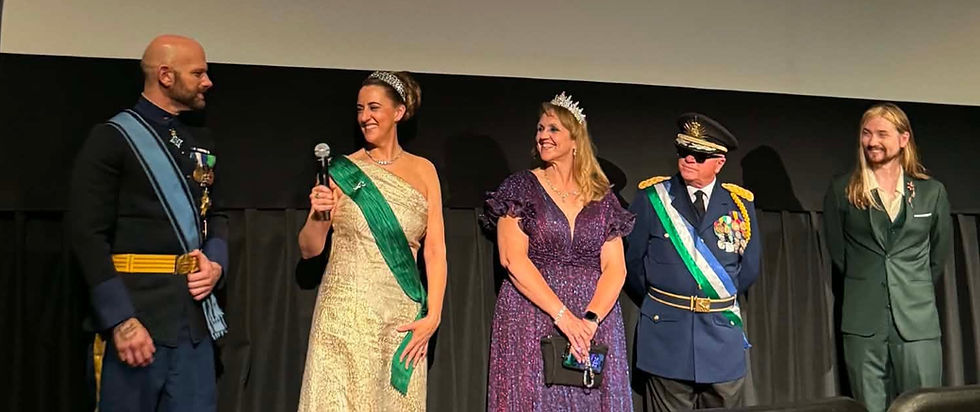
The fifth edition of the Micro Euro Summit took place from August 14 to 16 in Brno, Czech Republic. Born four years ago out of an initiative that was primarily Central European, the MES now appears to have reached a new milestone: that of a truly pan-European gathering. Beyond the number of delegations in attendance, the topics addressed during the conferences also reflect a form of micronationalism that is increasingly examining its own identity, symbols, and place in society.

From five micronations in 2022 to a European gathering
There was still an experimental feel to the event when the first Micro Euro Summit (MES) was held in 2022 at Chyše Castle in the Czech Republic.
At the time, only five micronations took part in that inaugural gathering: Obscurium, Duckionary, Musania, Waronia, and Edristan. The initiative—spearheaded notably by Zar Antonov of Obscurium and Arthur de Tourneau of Duckionary—was driven by a simple realization: Europe lacked a regular annual event where micronationalists could easily meet up on the continent. Four years later, the landscape has changed significantly. After being held at Chyše in 2022, 2023, and 2024, and in the Kingdom of Romkerhall (Germany) in 2025, the MES returned to the Czech Republic this year—but this time to the heart of Brno, within the prestigious setting of the Old Town Hall.
This 2026 edition marked the fifth Micro Euro Summit. The MES has thus established itself as a regular fixture on the European micronational calendar.
22 micronations and eleven countries represented
The geographical distribution of the delegations present in Brno is arguably one of the most interesting takeaways from this edition. According to information gathered by Microcosme, 22 micronations were represented, with members based in twelve different countries.
Germany remains the leading country of origin, with six micronations represented: Obscurium, Waronia, Musania, Zelesynthe, Bavaria and Saxony, and the Pastafarian Order of the Noodle.
Next come France and Greece, with three micronations each. France was represented by the Principality of Aigues-Mortes, Ferthroy, and Dibistan; Greece by Arkaland, Loutrakion Hill, and Graecia. United Kingdom was represented by Drasilia and Rockall. The host country, the Czech Republic, was represented by two micronations: Mendersia and Mekniy and Lurk. Finally, Austria, the Netherlands, Slovakia, Lithuania, and Estonia each had one representative, alongside Slowjamastan, which traveled from the United States.
Of the 22 micronations recorded, 21 were therefore European. Under these circumstances, it is difficult to continue viewing the Micro Euro Summit as a gathering that is essentially German and Central European in nature.

Has the MES truly become European?
Germany undeniably retains significant weight at the summit. With six delegations, it alone accounts for a quarter of the micronations present. This is hardly surprising. The MES originated in a predominantly German-speaking, Central European environment, and its organizers have long maintained a particularly active network spanning Germany, Austria, and the Czech Republic. However, the picture in Brno now reveals a different reality. France, the United Kingdom, Greece, the Netherlands, Italy, the Baltic states, and Central Europe make for a far more diverse group than in the early editions. The MES thus appears to have gradually evolved from a regional network into a continental one. Nevertheless, significant gaps remain.
Italy, Spain and Portugal, the notable absentees
One absence is particularly notable: no Italian, Spanish or Portuguese micronations appear among the delegations recorded in Brno. This paradox is interesting, given that the italian and Iberian Peninsulas are by no means devoid of micronational activity; Spain, in particular, boasts a remarkably prolific and diverse scene, while several projects remain active in Portugal. The phenomenon may thus reveal the existence—within European micronationalism itself—of several networks that remain relatively unfamiliar with one another.
Alongside the Anglophone and Central European sphere—now highly interconnected through the MES and MicroCon—there exist Francophone, Hispanophone, and Lusophone communities that often maintain their own networks and operating methods.
One of the upcoming challenges for a truly European micronational organization will undoubtedly be to successfully build more bridges between these various communities.

What do the 2026 micronationalism conferences tell us?
The Brno program also reflects a deeper evolution. The presentations selected this year went beyond mere diplomacy or individual showcases of the participating micronations; they explored, on a much broader scale, the very elements that go into building a nation.
Archduke Arthur I of Duckionary, for instance, gave a presentation titled "Micronations by the Danube," situating the micronational phenomenon within its geographical and historical context. Meanwhile, President Antonov of Obscurium led two workshops focused on heraldry and the creation of micronational medals. These two themes might appear to be merely matters of protocol, yet they actually touch upon a fundamental concern for micronations: how to craft symbols capable of forging a history, an identity, and a sense of belonging. Grand Master Paul Paccheri of the Krker Order raised another question that was almost existential in nature: "How Big can a Micronation be?"
This is a particularly relevant question at a time when some micronational projects are no longer limited to just a few individuals, but are instead developing international communities, administrations, media outlets, events, and diplomatic relations. Even more original was the presentation by Quintus De Vitaliis about Conlangs.
Producing, cultivating, or creating something within a territory thus becomes far more than a mere economic activity; it contributes to shaping a collective narrative and rooting an identity.
Finally, Jürgen Schwarz, Postmaster General of the Federated Micronations of Musania, dedicated his talk to Leopold Kohr and his political philosophy of "small nations." This is a particularly relevant reference for the micronational movement, given that the Austro-American thinker championed the idea that small-scale structures could offer a solution to the excesses of political systems that had grown too large.

From Folklore to Nation-Building
Taken together, these topics reveal a trend.
From heraldry, decorations, territory, agriculture, and state size to national identity and political philosophy, micronations today seem more focused on reflecting on their own makeup than merely on the question of recognition.
European micronationalism thus appears to be gradually maturing. It is no longer just a matter of proclaiming a state, designing a flag, or establishing diplomatic ties with other projects. Some participants now seek to add greater depth to their constructs: creating a culture, passing on a history, developing traditions, producing objects, organizing a community, and reflecting on what it ultimately means to "be a nation."
The group discussion held in Brno by Dr. Petermann from the University of Mainz—which focused on major issues currently relevant to the micronational world—also highlights another phenomenon: micronationalism itself is becoming a subject of academic study and reflection.
The boundaries between institutional game, social experiment, artistic project, cultural community, and political laboratory remain deliberately porous. That is perhaps precisely where part of its richness lies today.
A summit at a turning point in its history
Brno may well go down as a pivotal event. This is not only because the fifth edition confirms that the Micro Euro Summit has moved well beyond the Central European circle of its early days, but above all because the landscape of European micronational gatherings is poised for a major transformation.
There will be a next Micro Euro Summit in 2028 in its usual format. The next major European event will be MicroCon EU 2027, organized by the Principality of Aigues-Mortes and held on September 24, 25, and 26, 2027, in Aigues-Mortes, France.
Several major North American micronations have already announced their participation in the Aigues-Mortes event, turning this upcoming European gathering into a genuine bridge between the micronational communities on both sides of the Atlantic.
This coming together is all the more symbolic given that 2027 will see two MicroCons held just weeks apart: a North American edition in San Diego, hosted by the Republic of Slowjamastan, and the European edition in Aigues-Mortes.
The challenge is no longer merely to bring together Europe’s micronations. It will be to better link them with one another—and then to establish lasting connections between Europe and the rest of the micronational world.



Commentaires